

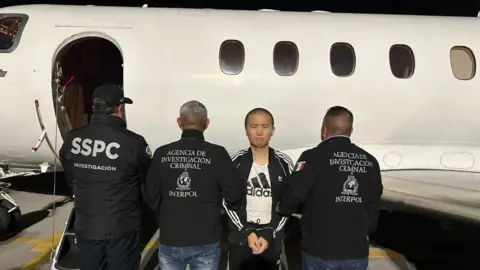
 Secretary of Mexico's Public Safety Department
Through a evening announcement this past Thursday, Cuban authorities stated that it had extradited an individual from China, Zhang Zhi Dong, to Mexican officials. Shortly after, the nation's top security officer verified his subsequent extradition to the United States on drug trafficking and money laundering charges.
This concluded a months-long, daring flight effort by one of the world's most wanted fugitives.
Referred to by multiple names including Brother Wang, Pancho and HeHe, Zhang Zhi Dong faces charges from US prosecutors for orchestrating a vast international ring of fentanyl trafficking and money laundering covering numerous nations but particularly China, Mexico and the US.
The list of charges against Mr Zhang is long but in essence American and Mexican legal authorities allege his significant role within international narcotics trafficking. Authorities claim he processed vast sums in drug money on behalf of the Sinaloa and Jalisco cartels within a global narcotics supply chain.
"Brother Wang can be seen as an essential connection between Mexican cartels with chemical firms in China in sourcing the pre-cursor chemicals for fentanyl", notes ex-DEA officer, Mike Vigil, who emphasized his crucial role in transforming narcotics profits into digital currency.
If convicted, Zhi Dong Zhang may face a comparable outcome as other drug kingpins like Joaquin 'El Chapo' Guzman and Ismael 'El Mayo' Zambada in a high-security facility in the United States.
But how 'Brother Wang' ended up in custody in Havana represents a remarkable story featuring an escape from home confinement in Mexico City, reportedly through a hole in a wall, boarding a private aircraft to Cuba and a finally unsuccessful effort to enter to Russia.
Zhang's initial arrest occurred within the Mexican capital in a joint security operation in October 2024. He was first detained inside a high-security penitentiary but was later granted house arrest by a judge – a ruling President Claudia Sheinbaum labeled "shocking".
Brother Wang's escape displayed all the characteristics of another embarrassing episode for Mexico: an individual deemed crucial in the machinery of drug smuggling, managing to vanish from under the noses of the Mexican authorities assigned to monitor him. El Chapo Guzman managed that feat twice, to great US annoyance, before he was finally put on a plane in handcuffs to the US.
That Mexican authorities were able to recover their prisoner coupled with his northern transfer came down to two things – an apparent stroke of luck in Russia and robust Mexico-Cuba security ties.
When Zhang reached Cuba in July 2025, he set about making his next steps aiming to access a nation with no extradition treaty with the US, officials say.
There is a direct commercial flight between Havana and Moscow and Zhang, authorities claim, was able to secure a seat on it with fraudulent documents. Yet, these documents failed to clear Russian immigration officials. Reports indicate Russian authorities didn't fully recognize the identity of their detainee and, following short-term detention, they turned Zhang around returning him to Cuban territory.
Following his second Havana arrival, the Cuban security services were now aware regarding his true identification.
Security analysts believe Cuban officials retained him for several months to interrogate him at length prior to his Mexico repatriation and, ultimately, transfer to the United States. Mexico's Public Security Secretary, Omar Harfuch, promptly expressed gratitude to Cuba for their collaboration regarding 'Brother Wang' – essentially, preventing further embarrassment concerning another fleeing notable inmate.
As always following the arrest of an alleged kingpin, attention turns to how far their removal will affect international narcotics trafficking.
Considering his recent year either in prison, under house arrest or on the run, this inquiry might be irrelevant, Vigil commented, as his absence has already largely been felt within Mexico's illicit circles:
"There will be minimal effect because cartels already employ personnel who can start to replace to Brother Wang", Vigil states. "Even in the case of El Chapo Guzman who was a much bigger figure, it had no impact on the global drug trade", he contends.
Over his first year in office, American President Donald Trump has urged Mexico's leader to intensify fentanyl trafficking efforts and the Sheinbaum government has correspondingly acted. She has significantly increased seizures of the drug relative to the prior administration and has extradited numerous convicted cartel affiliates to the United States for sentencing. They included several high-level drug names such as Rafael Caro Quintero, sought for a 1985 DEA agent killing.
Her cooperation on the fentanyl issue, as well as on undocumented immigration, is considered the reason Trump has avoided implementing equivalent trade duties against Mexico as applied to other trade allies.
Brother Wang's extradition will provide real gratification in Washington at having taken a key figure from cartel financial activities from operation. This, subsequently, will satisfy Mexico's Sheinbaum government and strengthen their claim to be in lockstep with their US counterparts on security.
Nonetheless, curbing or diminishing the flow of precursor substances for fentanyl from China to the Americas in any sustainable manner requires more than one individual's extradition.

